
The Islamic necropolis of Tauste (Zaragoza, Spain)
Project proposal: DNA analysis, radiocarbon dating and paleodiet study
Researchers
- Lara Fontecha – Researcher (Official School of Biologists)
- Miriam Pina – Anthropology
- Francisco Javier Gutiérrez – Archaeology
Index
- Summary
- 1. Introduction
- 2. Fundaments of the research
- 3. Project team
- 4. Project scope
- First research: DNA analysis
- Second research: Paleodiet study
- Third research: Radiocarbon dating
- Target outcomes and dissemination of results
- Download this project proposal report
Summary
Archaeological excavations carried out in the Spanish town of Tauste (Zaragoza) between 2010 and 2013, and promoted by the Cultural Association ‘El Patiaz’, have exposed a medieval necropolis characterized by a Muslim burial ritual (maqbara).
This project proposes a three-line investigation — by independent studies of DNA, paleo diet and radiocarbon analysis to ratify the results that place the necropolis between the 8th and 11th centuries — in order to focus the investigation of this Islamic cemetery from a multidisciplinary approach.
Key words: Archaeology, anthropology, DNA analysis, paleo diet, radiocarbon.
1. Introduction
Located in the north of the province of Zaragoza, Tauste is one of the Five Historical Villas of Aragon. Until recently, very little was known about its Islamic past. The presence of a Muslim population in the city was considered merely anecdotal.
Studies on the origin of the tower of St. Mary in Tauste considering it a minaret of the 11th century and associating it to the existence of an Islamic population capable of undertaking this huge work led to the Cultural Association «El Patiaz» of Tauste to initiate investigations to find vestiges of these people.
The result was the discovery of a large Islamic cemetery, estimated to number about 4,500 burials. The cemetery also has at least two levels. Using carbon-14 dating, it has been determined that this is one of the oldest necropolis of Spain, with evidence of a tomb in the mid-eighth century; it is the oldest dated Islamic tomb of Aragon.
2. Fundaments of the research
So far, the Cultural Association “El Patiaz” of Tauste has organised four excavation campaigns, the last held in summer 2013, which included a field of work with the participation of university students.
The work of volunteers has been fundamental in the development of this project, because the only economic resources for this research have been the contributions of civil society of Tauste.
3. Project team
To set about this task, PhD in Biology Lara Fontecha (human genetics, DNA in ancient remains and biomedicine), anthropologist Miriam Pina (director of anthropological laboratory) and archaeologist Francisco Javier Gutierrez (coordinator of the excavation) formed a research group.
4. Project scope
This project proposes a three-line multidisciplinary research by DNA-analysis, paleodiet study and radiocarbon dating.
First research: DNA analysis
The project in the context of international research
Ancient DNA analysis has had a recent development, limited by its methodological complexity and its high cost, especially in anthropology.
The aim is to determine whether the cultural influence of the Islamic world in the necropolis has a biological correspondence.
Objectives
- Recover ancient DNA from skeletal remains
- Study mitochondrial DNA variability
- Determine molecular sex
- Analyse Y-chromosome SNPs
- Replicate results in an independent laboratory
Timeline
Sample selection, DNA extraction, quantification, analysis, replication and interpretation over a two-year period.
Budget
Estimated cost: 20,000 €.
Second research: Paleodiet study
Objectives
To reconstruct dietary habits through isotopic and trace element analysis.
Methodology
- ICP-MS analysis
- Stable isotope analysis (δ13C, δ15N)
- Trace elements (Ba, Sr, Zn, Cu)
- FTIR for diagenetic alteration
Working period and budget
Estimated duration: 12 months.
Estimated cost: 2,325.50 €.
Third research: Radiocarbon dating
Objectives
To ratify and refine the chronological framework of the necropolis.
Scope
Radiocarbon dating of samples from different excavation campaigns to compare results.
Working period and budget
Estimated duration: 6–12 months.
Estimated cost: 2,800 €.
Target outcomes and dissemination of results
The project aims to advance methodological approaches in archaeogenetics and contribute to the understanding of population history and Islamic presence in medieval Aragon.
Download this project proposal report
The Islamic necropolis of Tauste (PDF)
Links
- Academic world (archaeology and anthropology)
- Press, radio and television
- Cultural dissemination
 TEXTO DESPUÉS DEL ENLACE…
TEXTO ANTES DEL ENLACE…
TEXTO DEL ENLACE AQUÍ
TEXTO DESPUÉS DEL ENLACE…
Al día siguiente partieron hacia Alcázar de San Juan, donde comenzaban los actos oficiales con una misa multitudinaria. En las ofrendas, cada grupo presentó algo típico de su tierra. Tauste llevó
una culeca de novia
 .
que causó admiración y curiosidad entre todos los presentes.
.
que causó admiración y curiosidad entre todos los presentes.
——————————————-
Tauste llevó
una culeca de novia
.
que causó admiración y curiosidad entre todos los presentes.
A partir de ese hallazgo, y gracias a una petición que hicimos en nuestras redes sociales, empezaron a llegar recuerdos, fotografías y testimonios… y así pudimos reconstruir una historia maravillosa: el viaje del Orfeón de Tauste a Alcázar de San Juan, donde
conquisto el primer premio
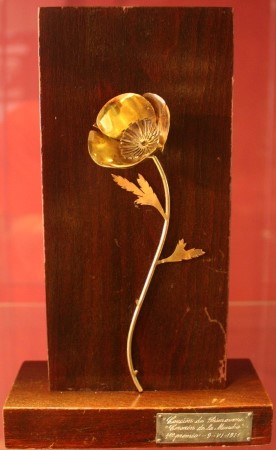 .
del VII Festival de la Canción de Primavera y trajo a casa la amapola de oro
Gracias a todas las personas que han compartido sus vivencias y han permitido rescatar este capítulo inolvidable de la historia musical de nuestro pueblo.
.
del VII Festival de la Canción de Primavera y trajo a casa la amapola de oro
Gracias a todas las personas que han compartido sus vivencias y han permitido rescatar este capítulo inolvidable de la historia musical de nuestro pueblo.
El Archivo de Tradición Oral de Tauste forma parte de un valioso proyecto de recuperación de la memoria popular llevado a cabo a principios de los años noventa por Mario Gros y Luis Miguel Bajén.
A través de los siguientes apartados podrás acceder a las distintas manifestaciones de nuestra tradición oral. En todos ellos se ha respetado la expresión y grafía original de los autores.
Aunque esta recopilación que presentamos aquí se centra exclusivamente en los testimonios recogidos en Tauste, prestando especial atención a sus manifestaciones musicales y etnográficas, su trabajo abarca buena parte de las Cinco Villas y constituye una de las investigaciones más completas sobre la tradición oral aragonesa.
Canciones de cuna
Intérprete: Fina Francés Ejea
Intérprete: Mª Nieves López Chacorrén
Intérprete: Mª Nieves López Chacorrén
Intérprete: Mª Nieves López Chacorrén
Intérprete: Mª Nieves López Chacorrén
Intérprete: Trini Sánchez Betés
Intérprete: Pilar Sanz Aguerri
Intérprete: Elena Latorre Casajús
Intérprete: Elena Latorre Casajús
Intérprete: Elena Latorre Casajús
Intérprete: Elena Latorre Casajús
Intérprete: Informante Tauste 2
Intérprete: Ascensión Montolar Vera
Juegos infantiles
Intérpretes: Delia Beltrán Pola
Intérpretes: Luisa Pola Pola, Delia Beltrán Pola y Carmen Lambán Aragüés
Intérpretes: Pili Lorente Lasala
Intérpretes: Pili Lorente Lasala
Intérpretes: Pili Lorente Lasala
Intérpretes: Pili Lorente Lasala
Intérpretes: Pili Lorente Lasala
Canciones de cuna
Intérprete: Fina Francés Ejea
Intérprete: Mª Nieves López Chacorrén
Intérprete: Mª Nieves López Chacorrén
Intérprete: Mª Nieves López Chacorrén
Intérprete: Mª Nieves López Chacorrén
Intérprete: Trini Sánchez Betés
Intérprete: Pilar Sanz Aguerri
Intérprete: Elena Latorre Casajús
Intérprete: Elena Latorre Casajús
Intérprete: Elena Latorre Casajús
Intérprete: Elena Latorre Casajús
Intérprete: Informante Tauste 2
Intérprete: Ascensión Montolar Vera